Wolf Oven Not Heating Evenly? Here's What's Actually Going On
Uneven baking in a Wolf oven almost always traces to one of four causes. Here's how to diagnose each, plus the calibration step most homeowners skip.
Expert answer
Quick answer for homeowners
A Wolf oven that heats unevenly usually has a convection fan issue, weak or failed heating element, temperature sensor drift, door-gasket leak, or calibration problem. Test the oven with a probe thermometer before replacing parts, because some cases can be corrected with calibration.
- A silent convection fan in convection mode is a strong diagnostic clue.
- A consistent temperature offset may be calibration rather than parts failure.
- A door gasket leak can create uneven baking without triggering an error code.
Reviewed for accuracy
Reviewed by Akra Appliance Repair technicians
This guide is reviewed by the Akra Appliance Repair team that services premium appliances across Irvine and Orange County. California-Licensed Appliance Repair · BHGS Reg. #A50034 · EPA 608 Certified · Licensed & Insured. Last updated: September 23, 2025.
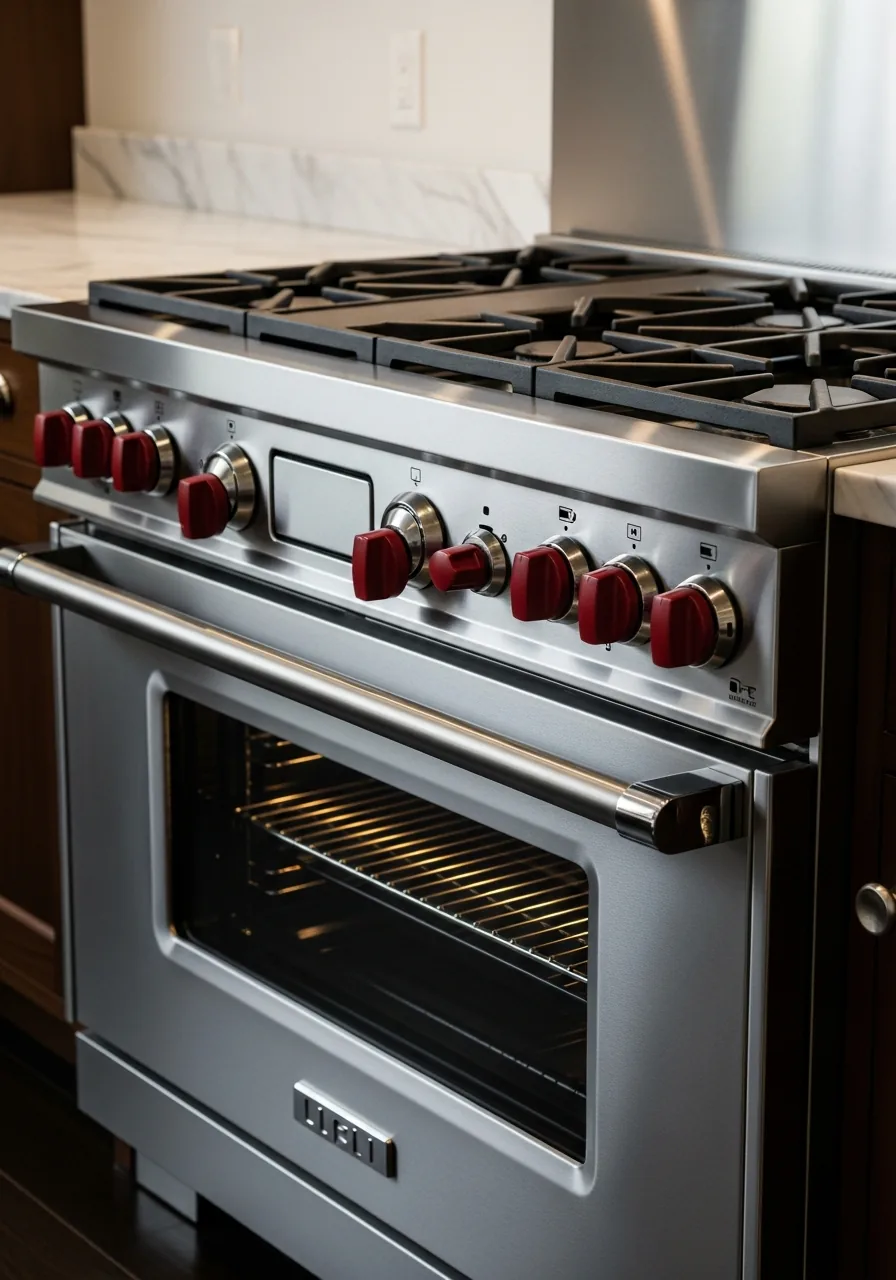
A Wolf oven that bakes unevenly is frustrating because the unit usually does not throw an error code — it just produces cookies that are dark on one side and pale on the other, or a roast that is well-done at the back and underdone at the front. Almost every uneven-heating call we run traces to one of four causes. Here is how to work through them.
Cause 1: Convection Fan Not Running
On Wolf convection ovens, the rear convection fan circulates heated air to even out temperature across all racks. If the fan motor has failed or the fan blade is loose on the shaft, you lose convection function and the oven reverts to dramatic top-to-bottom temperature gradients. Test: preheat to 350°F in convection mode and listen at the back of the oven for fan noise. Silence = failed motor. We replace these regularly on Wolf E Series and M Series units past year seven.
Cause 2: One Heating Element Has Failed
Wolf ovens use a bake element (bottom) and a broil element (top). If the bake element has partial failure — a hot spot or an open break — the oven still reaches setpoint using the broil element but the heat distribution is wildly off. Visual inspection at room temperature usually reveals it: a bubble, blister, or visible break in the element coil. Replacement is straightforward but requires pulling the oven from the cabinet, which is a tech job on built-in models.
Cause 3: Temperature Sensor Drift
The oven temperature sensor (a thin probe that pokes into the upper rear of the cavity) is what tells the control board when to cycle the elements. As it ages, the resistance curve drifts and the actual cavity temperature no longer matches the setpoint. Symptom: the oven reads 350°F but a probe thermometer placed inside reads 325°F or 380°F. A 15-25°F drift is correctable through Wolf's user-accessible calibration menu (your owner's manual has the steps). Anything more than that means the sensor needs replacement.
Cause 4: Door Seal Failure
The oven door gasket should compress evenly all the way around when the door closes. If it has hardened, torn, or pulled loose at a corner, hot air leaks out and the oven runs cooler on that side. Run your hand around the door perimeter during preheat — you should not feel hot air escaping anywhere. A new gasket runs about $180 installed and fixes the uneven baking immediately.
Wolf ovens have a hidden calibration offset (often called 'TEMP CAL' or 'OVN CAL') that lets you shift the entire temperature curve by ±35°F in 5° increments. If your oven runs consistently cool or hot relative to your probe thermometer, calibrate before assuming anything is broken. About 30% of 'uneven heating' calls we get are actually just an uncalibrated oven.
How to Test Properly
- Place a quality probe thermometer in the center of the middle rack.
- Preheat the oven to 350°F and let it sit at setpoint for 20 minutes.
- Record the actual temperature.
- Move the probe to the back-left corner, repeat. Then back-right, front-left, front-right.
- Any spot more than 25°F off from the center reading indicates a real distribution problem, not just calibration.
Rack Position and Cookware Variables People Forget
Before you spend on diagnosis, rule out the user-side variables. Wolf ovens are calibrated assuming the food is on the center rack with at least 2 inches of clearance on all sides. Crowding two large sheet pans onto a single rack creates an airflow shadow that bakes the second pan unevenly even on a perfectly tuned oven. Same with using dark anodized pans on the top rack and shiny aluminum on the bottom — the radiant transfer characteristics are wildly different and you will get different browning even when the air temperature is identical.
Stone or steel baking surfaces are another common source of complaints. A pizza stone left in the oven full-time changes the thermal profile significantly. Heated dense mass radiates differently than the convection-only air the oven was tuned for. If you bake with a stone, take it out for delicate baking — cakes, soufflés, anything where rise depends on consistent heat from all directions. Bring it back in for breads and pizzas where the radiant floor heat is the whole point.
How We Diagnose On Site
When we run an uneven-heating call, we bring a thermal mapping probe, a manometer for gas pressure verification (on dual-fuel and gas Wolf models), and a digital multimeter for element and sensor testing. The first 20 minutes are diagnostic — we do not start replacing parts on guess. Once we have the data, we will tell you which of the four causes is responsible and quote the actual fix before we touch anything.
If calibration does not fix it, or if the temperature variation across racks exceeds 25°F, the issue is mechanical and needs a tech. Akra Appliance Repair services every current Wolf oven line including E Series, M Series, L Series, and the legacy Convection Steam ovens. Call (949) 666-8689.
Expert FAQ
Why is my Wolf oven baking unevenly?
The most common causes are convection fan failure, a weak bake or broil element, temperature sensor drift, door seal leakage, or an oven that needs calibration.
Can Wolf oven calibration fix uneven heating?
Calibration can help when the entire oven runs consistently hot or cool. If different areas vary widely, the issue is more likely airflow, a heating element, or the door seal.
When should I call for Wolf oven repair?
Call if the fan is not running, temperature varies more than about 25°F across the cavity, the element is visibly damaged, or calibration does not correct the problem.
Related repair pages
Use these internal links to continue from this expert guide to the matching service, brand, location, promotion, and scheduling pages.
More From the Blog
Viking Refrigerator Has Warm Spots? Here Are the 5 Causes We See Most
Miele Dishwasher Error Codes Explained: F11, F12, F14, F18 and What They Actually Mean
Sub-Zero vs Thermador Built-In Refrigerators: An Honest Comparison From the People Who Repair Both
Wolf vs Viking Ranges: Which One Should You Repair, and Which One Should You Replace?
Sub-Zero Refrigerator Not Cooling? What to Check Before Food Spoils